
ServicesWeb applicationsStartups to enterprise
Fast, secure web platforms for customers, partners, and internal teams.

Overview
What this service covers.
We build web applications for products and operations: SaaS products, customer and partner portals, internal platforms, dashboards, and API-connected business apps. The focus is maintainable software delivered through the browser, not brochure websites.
A web application is software people log into to get work done: a SaaS product, a customer portal, an internal platform or a dashboard over your operational data. It has users with different roles, data that has to stay correct, and workflows that change as the business does.
We design and build web applications on a modern TypeScript stack, typically Next.js and React on the front end with Node.js services and PostgreSQL behind them, and deliver them in a state your team can run and extend.
A strong fit when
- You are launching a SaaS product or a new module and need a production-ready first version.
- Customers, partners or field teams need a portal instead of email threads and shared files.
- Internal teams run important work out of spreadsheets that have become fragile.
- An existing web app is slow, hard to change or built on a stack your team can no longer support.
Consider another route when
- You need a campaign or brochure website. A marketing agency or a website builder is a better fit.
- The main experience has to work offline on a phone. Mobile app development is usually the better starting point.
Capabilities
What we deliver.
- 01
SaaS and product web apps
Multi-user application surfaces with roles, workflows, and room to add modules later
- 02
Portals and internal platforms
Customer, partner, and operator portals with clear information architecture
- 03
Dashboards and business apps
Operational views and tools that sit on top of your data and services
- 04
API-connected frontends
Reliable interfaces on REST or GraphQL services your systems already use
- 05
Modernization of existing web apps
Improve the highest-risk areas first so you can keep shipping while the system improves
- 06
Handover-ready delivery
Documented code and deployment paths so your team can operate what we build
Tools and technologies
- Next.js / React
- Node.js
- TypeScript
- PostgreSQL
- API-backed UIs
- Cloud deployment
Approach
How we think about it.
- 01
What makes a web application different from a website
A website mainly publishes information. A web application holds state: accounts, permissions, records, approvals, payments and history. That changes the engineering priorities. Data integrity, access control, auditability and performance under real usage matter more than page transitions.
We start from the data model and the workflows, then design the interface around them. That order keeps the product consistent as features are added, because new screens build on the same entities and rules instead of inventing their own.
- 02
Portals and internal platforms
Portals often replace a mix of email, shared drives and manual updates. The value comes from giving each type of user exactly the view and actions they need: customers see their orders and documents, partners see their pipeline, operators see the queue they are responsible for. We design roles and permissions early because they shape almost every screen.
Internal platforms are judged differently from customer-facing products. Speed of common tasks, keyboard-friendly forms, bulk actions and reliable search usually matter more than visual polish. We optimize for the people who use the tool all day.
- 03
Modernizing an existing application
Rewriting a working application from scratch is rarely the safest option. We start with a technical assessment to find where the real risk sits, whether that is an unsupported framework, a tangled data layer or missing tests, and address those areas first while the product keeps shipping.
Where a rewrite is justified, we migrate in slices behind stable URLs and APIs so users move to the new version gradually rather than all at once.
How we work
From scope to release.
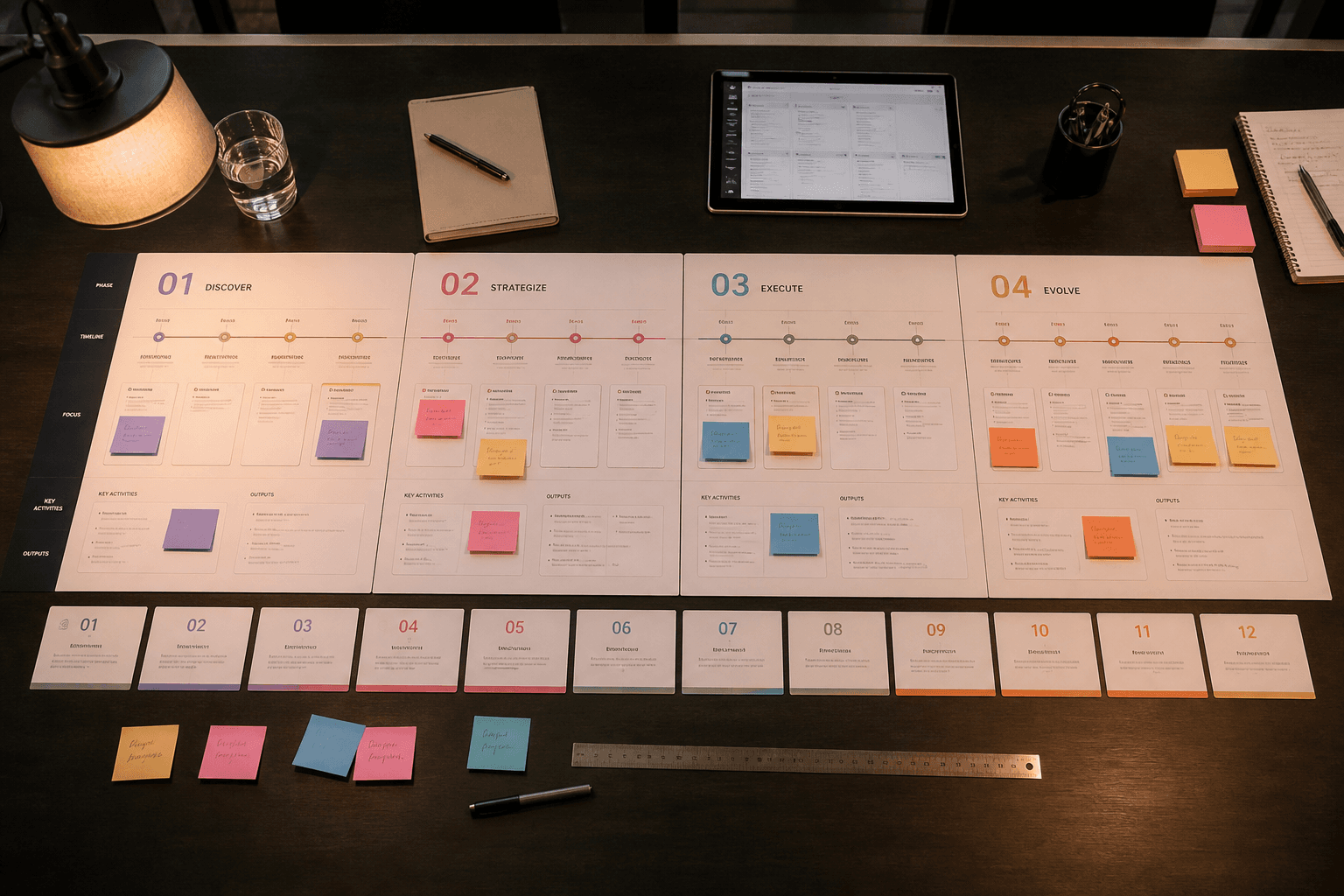
01
Stage 1Discovery and requirements
- You get
- User roles, core workflows, data entities and the first release scope written down and agreed.
02
Stage 2Architecture and UX alignment
- You get
- Architecture and key screen flows aligned before build, so design and engineering agree on the same product.
03
Stage 3Build in visible iterations
- You get
- Deployed preview environments at each iteration, so stakeholders review working features.
04
Stage 4QA and hardening
- You get
- Tested critical paths, accessibility and performance checks, and security review of auth and data access.
05
Stage 5Launch and handover
- You get
- Production launch, monitoring, documentation and a handover window with your team.
Related work
Web applications in practice.
Explore the full portfolioAll case studies
FAQ
Common questions.
Related services
Often combined with.
 Product design that makes complex software clear and usable.
Product UI/UX design
 Cloud infrastructure and delivery pipelines built for reliable releases.
Cloud and DevOps
 Connected systems, so data moves reliably across the business.
System integration
Explore every capabilityAll services
Let’s build what’s next
Tell us what you are building and we will show you how we would deliver it.