01
Data Integration
A secure, read-only connection to the customer's existing EHR or PMS. No migration, no write access, no change to how the billing team works.
Case study · Acuron.ai
Healthcare · Revenue Cycle · AI & Data
Simplify RCM analytics and surface CFO-ready answers from the EHR systems practices already run — without disrupting billing workflows.
Most billing data never reaches the people who need it — at least not in time to act on it. A denial trend that starts in week one surfaces in a monthly report in week six, by which point the payer has rejected another few hundred claims on the same code.
The data already exists inside Epic, Cerner and athenahealth. The problem is access. A CFO who wants to know why net collection rate slipped has to file a request with an analyst and wait. Traditional RCM reporting is built for retrospective audit, not for the decision someone has to make today.
Collapse that gap. A read-only connection to the systems a practice already runs, a normalisation layer that makes KPIs comparable across locations and vendors, and an interface anyone in finance can use without learning SQL — shipped fast enough to matter.
Healthcare finance software is held to a standard most SaaS never meets. It touches protected health information, plugs into systems no vendor is allowed to disrupt, and its users are personally accountable for the numbers it produces.
PHI, handled properly — Every decision assumed protected health information. Encryption, tenant isolation, role-based access and audit logging were foundations — not a hardening sprint bolted on before the first enterprise security review.
Six schemas, one KPI — Epic, Cerner, athenahealth, NextGen, eClinicalWorks and Allscripts each model claims differently. Net collection rate has to mean exactly the same thing in all six before a single benchmark chart can be trusted.
AI a CFO can defend — A natural-language answer is worthless if the finance lead can't trace it. Every response resolves to a query, a filter set and a row count the user can open and inspect before taking it to a board meeting.
Zero workflow disruption — Read-only access, no replacement of the billing system, no retraining of staff. If onboarding cost a practice a week of downtime, nobody would buy it — so setup had to be measured in business days.
Off-the-shelf RCM reporting wasn't built for this. The product needed custom AI development — read-only EHR connectors, a shared KPI model, and answers a CFO can defend.
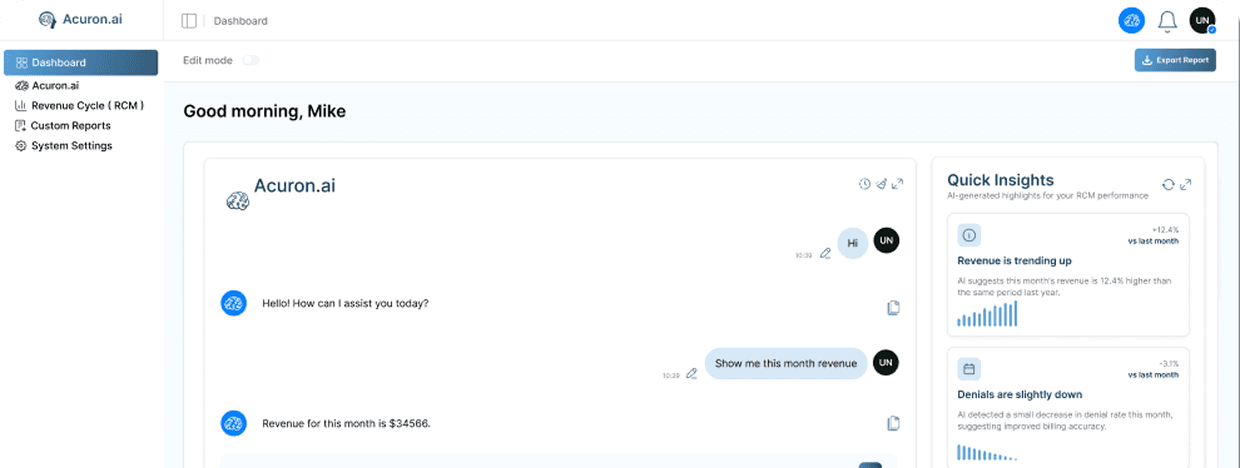
Acuron.ai · Dashboard
Total Charges
$77,600.00
Total Payments
$39,675.65
Total Adjustments
$26,209.35
Total AR Balance
$11,715.00
Top denial reasons
Ask Acuron
Which payers denied the most claims last quarter?
Six capabilities that make revenue cycle data accessible, understandable and actionable for every role — from the billing coordinator to the CFO.
Always-on analytics for collections, net collection rate, days in AR and payer performance.
Ask in plain English, get back charts, tables and the context needed to read them.
Top denial reasons with payer-level segmentation and alerts, caught before they compound.
Charge capture patterns and payment variance against expected rates, monitored continuously.
Normalised metrics comparing productivity across providers, specialties and locations.
AR aging and stuck-claim analysis with configurable bucket definitions per organisation.
Four stages between a practice management system and an answer on screen. The hard engineering is in the middle two.
A secure, read-only connection to the customer's existing EHR or PMS. No migration, no write access, no change to how the billing team works.
Near real-time sync of charge, claim, payment and denial data, with historical backfill and incremental updates thereafter.
A canonical RCM schema reconciling six vendors' data models into standardised KPIs — the layer that makes cross-location benchmarking possible at all.
KPI computation, anomaly detection and denial pattern analysis — plus the natural language layer that sits on top of it.
Integrations
Each handles its vendor's own claim model, and multiple sources can run at once for organisations with a mixed estate.

Full EHR integration with real-time charge and claim data sync.
Supported
Seamless connection for revenue cycle data ingestion and KPI tracking.
Supported
Cloud-native integration for ambulatory billing and collections data.
Supported
Connect practice management data for multi-location analytics.
Supported
Ingest billing and claims data for comprehensive revenue insights.
Supported
Supports multiple EHR/PMS sources simultaneously for unified analytics.
SupportedChoosing a technology partner usually comes down to trust in their judgment as much as their technical ability. Here's what that looks like in practice.
AI, engineering, infrastructure, and security sit under one roof — so a recommendation in one area accounts for its impact on the others, instead of optimising a single service in isolation.
Engagements are staffed and reviewed by engineers with real production experience in that specific domain, not generalists rotating across unrelated service lines.
You see working software at every sprint demo, with clear documentation of what's been built and what's still in progress — no black-box development cycles.
With teams across India, the UAE, Saudi Arabia, and the US, we align to your timezone and regional compliance requirements rather than forcing a single delivery model on every client.
Outcome & proof
Acuron needed revenue-cycle answers in seconds — without disrupting billing, without unexplained AI, and without a six-month integration project.
“CodexSmith built exactly what we scoped, on time, and asked the right questions before writing a line of code. Rare combination.”
We treated protected health data, multi-vendor KPIs, and inspectable AI as launch requirements, not a late hardening sprint. CodexSmith scoped the hard parts first, then shipped a product finance teams could open in a board meeting and stand behind.
Most of our clients don't come in needing exactly one service in isolation. A SaaS platform usually needs software development, DevOps to deploy it, and eventually AI features to stay competitive. A mobile app launch often needs penetration testing before release and application support after it. Because all of these practice areas sit inside one team, the handoffs between them don't involve re-explaining your product to a new vendor every time the scope shifts.
This also means recommendations are grounded in what's actually feasible to build and maintain — not shaped by which service a separate, siloed team happens to be trying to sell that quarter.
AI development, Agentic AI systems, and retrieval-augmented generation — built for production use, not just a proof of concept that stalls after the demo.
Software, mobile, SaaS, and web development covering the full product lifecycle from initial architecture to post-launch scaling.
DevOps and IoT for the systems running underneath your product, plus VR and AR development for the experiences that go beyond a flat screen.
Cybersecurity services, penetration testing, ongoing application support, and embedded product management for teams that need senior strategic input, not just execution.
Tell us what you're building and we'll come back with a scope, a timeline and a number.